


Why Traditional Data Centers Are Reaching Their Limits in the AI Era
June 9, 2026
Introduction: The Standard for Data Centers Is Changing in the AI Era
The rise of generative AI and large language models is significantly changing the role of data centers.
In the past, data centers were largely seen as spaces for reliably housing servers and network equipment. However, with the advancement of AI, data centers are no longer just facilities for storing servers. They have become complex infrastructure environments that must account for GPU server power consumption, heat generation, rack density, cooling methods, and operational efficiency.
AI competition is no longer just about model performance.
For companies to apply AI to real services and business operations, they need high-performance GPU servers, high-speed networks, large-scale storage, stable power supply, efficient cooling systems, and data center infrastructure capable of operating all of these components in an integrated manner.
In other words, data centers in the AI era are evolving from “spaces that house servers” into “strategic infrastructure that supports stable AI operations and improves cost efficiency.”
Why Changes in AI Infrastructure Are Putting Pressure on Traditional Data Centers
GPU-Centric AI Infrastructure Requires More Power and Cooling
The most significant change in AI infrastructure is the rapid advancement of GPU servers.
As AI models become larger, they require more computing resources. High-performance GPU servers are used to process these workloads. However, as GPU performance increases, power consumption also rises, and the amount of heat generated by servers increases as well.
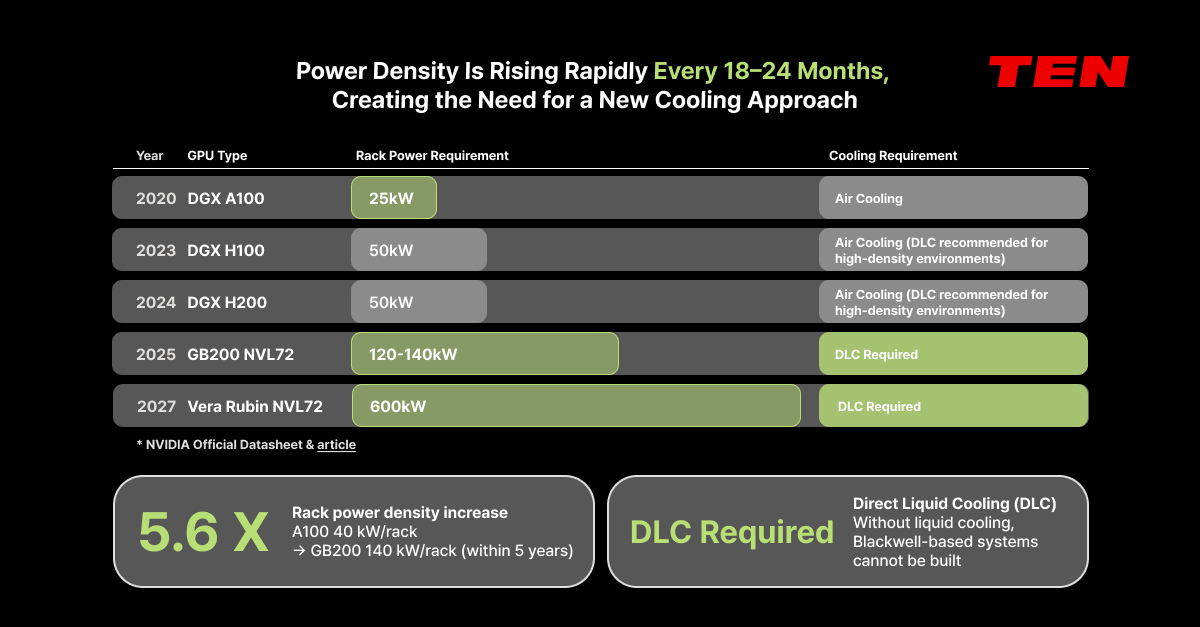
In particular, rack power density has been increasing rapidly in recent AI infrastructure environments. The rapid rise in power density and the emergence of new cooling methods, occurring roughly every 18 to 24 months, are requiring traditional data centers to be redesigned from the ground up.
For example, while A100-based AI infrastructure required approximately 25 kW per rack, GB200-based infrastructure may require up to around 140 kW per rack. This means that power requirements per rack have increased by approximately 5.6 times over the past five years.
When rack-level power requirements rise this sharply, it becomes difficult to operate high-density GPU servers reliably using the power distribution structures and cooling methods of traditional data centers.
Cooling methods are changing as well.
In the past, air cooling was often sufficient for many data center environments. However, as high-density GPU servers become more common, there are more cases where air cooling alone cannot sufficiently handle the heat generated by these systems.
In particular, next-generation AI infrastructure such as NVIDIA Blackwell-based systems is moving toward an environment where deployment becomes difficult without liquid cooling methods such as Direct Liquid Cooling, or DLC.
As a result, AI data centers can no longer be designed by first placing servers and then adjusting the cooling system afterward. They must be designed from the beginning around the power density and cooling requirements of GPU servers.
The Limits of Conventional Data Centers: Why the Old Approach Is No Longer Enough
Traditional data centers have strengths in terms of stability and scale.
However, in an environment where technology changes rapidly and power and cooling requirements increase sharply, as is the case with AI infrastructure, traditional approaches are facing significant limitations.
Limitation 1. Data Center Construction Timelines Cannot Keep Up with GPU Generation Cycles
One of the most pressing limitations of conventional data centers is how long they take to build.
A typical large-scale facility requires site acquisition, permitting, architectural design, power infrastructure, cooling systems, equipment installation, and testing — all before a single workload runs. For large-scale data centers, additional variables such as local community complaints, permitting delays, and power supply negotiations can extend the timeline far beyond the original plan.
These delays create an even bigger problem in AI infrastructure because AI servers and GPU generations change quickly. GPU generations turn over every 18 to 24 months, and new server architectures and cooling methods continue to emerge. As a result, infrastructure that was appropriate at the design stage may already be outdated by the time the data center is completed.
A similar issue occurred with one of TEN’s customers.
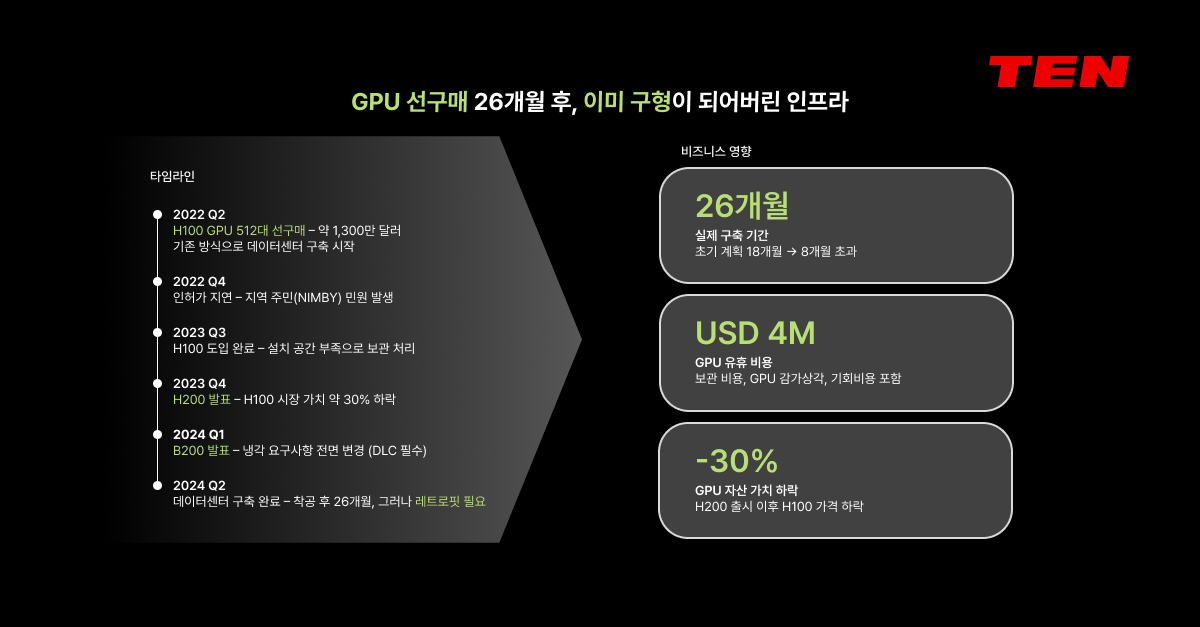
The customer had pre-purchased 512 H100 GPUs. However, while building the data center using a traditional approach, the project experienced permitting delays and local community issues, extending the construction period to 26 months. This was eight months longer than the original plan.
During this period, the high-value GPUs remained unused because they could not be installed. The idle GPU cost, including storage costs, depreciation, and opportunity costs, was estimated at approximately USD 4 million. In addition, after the release of H200, the price of H100 declined by around 30%, resulting in a loss of asset value.
A delay in data center construction is not simply a scheduling issue. It turns GPUs into idle assets and directly increases the cost burden of the entire AI infrastructure.
Limitation 2. Structural Changes Are Difficult After Completion
Another limitation of traditional data centers is structural rigidity.
Once a data center is completed, it is difficult to modify even when requirements change later.
For example, if a data center designed around air cooling later needs to support liquid-cooled GPU servers, simply adding cooling equipment is not enough. New cooling water piping may need to be installed, the power distribution structure may need to be changed, and rack layouts may need to be redesigned.
In some cases, operators may have to accept partial operational downtime, additional construction costs, and equipment replacement costs.
In areas such as AI infrastructure, where technology changes rapidly, this structural rigidity becomes a major risk.
Limitation 3. TCO Management Is a Core Competitive Factor for AI Data Centers
In AI infrastructure deployment, the initial construction cost is not the only important factor.
Companies must consider GPU purchase costs, power costs, cooling costs, data center leasing or construction costs, operating personnel costs, maintenance costs, and idle asset costs. This is known as TCO, or Total Cost of Ownership.
Even if a company secures high-performance GPUs, the overall cost burden can increase significantly if a data center capable of operating them reliably is not ready, or if power and cooling costs become excessive during operation.
Therefore, the key question for AI data centers is not “How large should we build?”
The real source of competitiveness is determined by “How quickly can we build, how flexibly can we expand, and how efficiently can we operate?”
Conclusion: AI Data Centers Need a New Deployment Model
GPU generations are changing rapidly.
Rack power density continues to increase, and cooling methods are shifting from air cooling toward liquid cooling. Amid these changes, traditional fixed data center construction models are showing limitations in both speed and flexibility.
Future AI data centers cannot rely solely on building larger facilities.
They must be able to deploy quickly and expand flexibly in response to changing GPU generations, power density, cooling methods, and AI workloads.
The solution that has emerged from this challenge is the modular data center, or MDC.
In the next article, we will look at what a modular data center is, how it differs from traditional data centers, and what differentiates TEN’s MDC in AI infrastructure deployment.
👉 Next Article: What Is a Modular Data Center?