


What Is Physical AI? U.S. Market Trends and Why AI Infrastructure Is Changing
June 8, 2026
Where Is the Market Headed After Generative AI?
For the past few years, generative AI has been the undisputed star of the AI market.
Since the rise of ChatGPT, AI systems that write text, generate images, and produce code have quickly entered both daily life and business operations. Companies began using generative AI to boost productivity, build new services, and reshape existing business processes.
But recently, the market narrative has started to shift.
Whether you look at YouTube, global tech news, or announcements from major AI companies like NVIDIA, one term keeps appearing again and again: “Physical AI.”
So what exactly is Physical AI, and why is the global AI market paying so much attention to it?
In this article, we will look at why Physical AI is gaining attention, with a focus on the U.S. market, and examine what new requirements this shift creates for AI infrastructure.
What Is Physical AI?
Put simply, Physical AI is AI that operates in the real world.
While generative AI mainly handles digital data such as text, images, and code, Physical AI recognizes physical environments through cameras and sensors, reasons about the situation, and then translates that understanding into real-world action.
For example, a robot assembling parts in a factory, an autonomous vehicle responding to road conditions, or a warehouse automation system adjusting movement routes in real time are all examples of Physical AI in action.
In this sense, Physical AI is not a single product category. It is a broader technology trend that includes robotics, autonomous driving, smart factories, logistics automation, and industrial vision AI.
And the implications go beyond robots getting smarter. For AI to operate in the physical world, everything has to be ready together: training data, simulation environments, inference systems, edge devices, and GPU infrastructure.
In other words, the rise of Physical AI also means that the standards for AI infrastructure are changing.
The Current State of the U.S. Physical AI Market
The growth outlook for the Physical AI market is accelerating. According to SNS Insider, the global Physical AI market is expected to grow from approximately USD 5.23 billion in 2025 to USD 49.73 billion by 2033, representing a projected CAGR of 32.53%.
[Source: SNS Insider, GlobeNewswire, 2025.12.05]
What stands out about the U.S. market isn't just the size of demand. What makes it particularly significant is that major players such as NVIDIA, Figure AI, Agility Robotics, Boston Dynamics, and Amazon Robotics are building the robotics and AI infrastructure ecosystem at the same time.
In other words, the U.S. Physical AI market is not simply a market where one type of robot product is growing. It's an ecosystem-level market where AI models, robot hardware, simulation, data, cloud, and edge infrastructure are all evolving together.
What GTC 2026 Revealed About the Direction of Physical AI
Physical AI has arrived — and every industrial company will become a robotics company."
— Jensen Huang, NVIDIA GTC 2026
NVIDIA GTC 2026 was an important event that showed Physical AI moving toward industrialization.
At GTC 2026, NVIDIA introduced Cosmos 3, Isaac GR00T N1.7, and the Physical AI Data Factory Blueprint. These announcements all focused on strengthening the training data, simulation, and inference infrastructure needed for robots, autonomous vehicles, and vision AI agents to operate in the real world.
The Physical AI Data Factory Blueprint is an open reference architecture designed to synthesize and expand edge-case data that is difficult or expensive to collect in robotics, vision AI agent, and autonomous vehicle development. Given that training data is one of the core bottlenecks in Physical AI development, this blueprint underscores a key point: competitive advantage will come not just from having a good model, but from how systematically you can generate and manage data that closely mirrors real-world conditions.
Cosmos 3 is a world model that processes language, images, video, and action data in an integrated way. It can be used to help robots and autonomous systems learn and validate various situations in a virtual environment before being deployed in the real world.
Isaac GR00T N1.7 was released with a commercial license as a foundation model for humanoid robots. NVIDIA also announced that its next-generation model, GR00T N2, is expected to achieve more than twice the task success rate in new environments compared to previous vision-language-action models.
These announcements show that competition in Physical AI is not only about robot hardware. Going forward, the competition is likely to shift toward full-stack capabilities that combine robot models, synthetic data, simulation, training infrastructure, and edge inference systems.
[Source: NVIDIA Newsroom, 2026.03.16]
The U.S. Government Also Sees AI and Robotics as Strategic Industries
U.S. government policy is moving in the same direction as the physical AI market.
America’s AI Action Plan, announced in July 2025, identified AI infrastructure expansion, regulatory streamlining, and broader AI adoption across industries as key priorities. The plan also highlights the potential of AI, robotics, and related technologies to create new capabilities in manufacturing and logistics, as well as in defense and national security.
[Source: The White House, America’s AI Action Plan, 2025.07]
This shows that the U.S. is not treating AI merely as a software competition. It is approaching AI as a broader industrial competitiveness issue that spans manufacturing, logistics, defense, and infrastructure.
The American Action Forum has also described Physical AI as a trend in which intelligence is being embedded into the physical world, with adoption expected to expand particularly in manufacturing and defense.
[Source: American Action Forum, 2026.04]
Taken together, the U.S. Physical AI market is growing at the intersection of private-sector technology competition and national industrial strategy. Manufacturing reshoring, logistics automation, defense technology modernization, and AI infrastructure investment are all contributing to this market’s growth.
Why Physical AI Infrastructure Is Different from Traditional AI Infrastructure
Physical AI requires a different infrastructure structure from traditional generative AI.
Generative AI mainly learns from digital data such as text, images, and code, and then produces digital outputs. Physical AI, on the other hand, must process camera footage, sensor data, robot behavior data, 3D spatial information, simulation data, and real-world feedback.
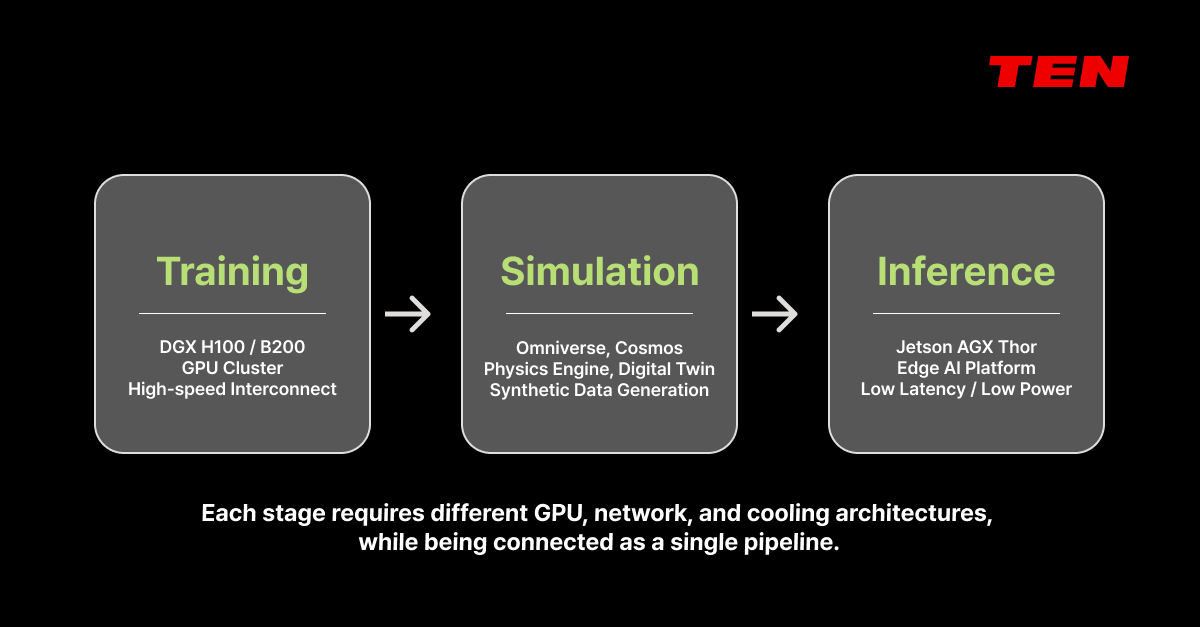
NVIDIA describes the development structure for Physical AI in three computing stages.
[Source: NVIDIA Blog, 2025.08.08]
First, Training: Building large AI models requires high-performance GPU clusters. Systems like the DGX H100 and B200 fall into this category. As models grow and data becomes more complex, GPU interconnect speed, storage throughput, and cluster operational efficiency all become critical.
Second, Simulation: Using Omniverse and Cosmos-based virtual environments, robots and autonomous systems are trained and validated before real-world deployment. Risky industrial scenarios, rare failure cases, and complex work environments can be repeatedly recreated in simulation, allowing companies to supplement real-world data with synthetic data. This requires infrastructure capable of handling physics engines, 3D rendering, and digital twin environments.
Third, Inference: Once trained, models are deployed on edge AI platforms like the Jetson AGX Thor, running directly on robots and physical equipment. In industrial environments, delayed decisions can lead not only to lower productivity, but also to safety risks. This makes low-latency and low-power inference design essential.
Each of these three stages requires different GPU configurations, network bandwidth, storage capacity, and cooling methods. And yet all three need to connect as a single pipeline. This is one of the biggest differences between Physical AI infrastructure and traditional generative AI infrastructure.
The Limitation of Physical AI: Edge Alone Is Not Enough
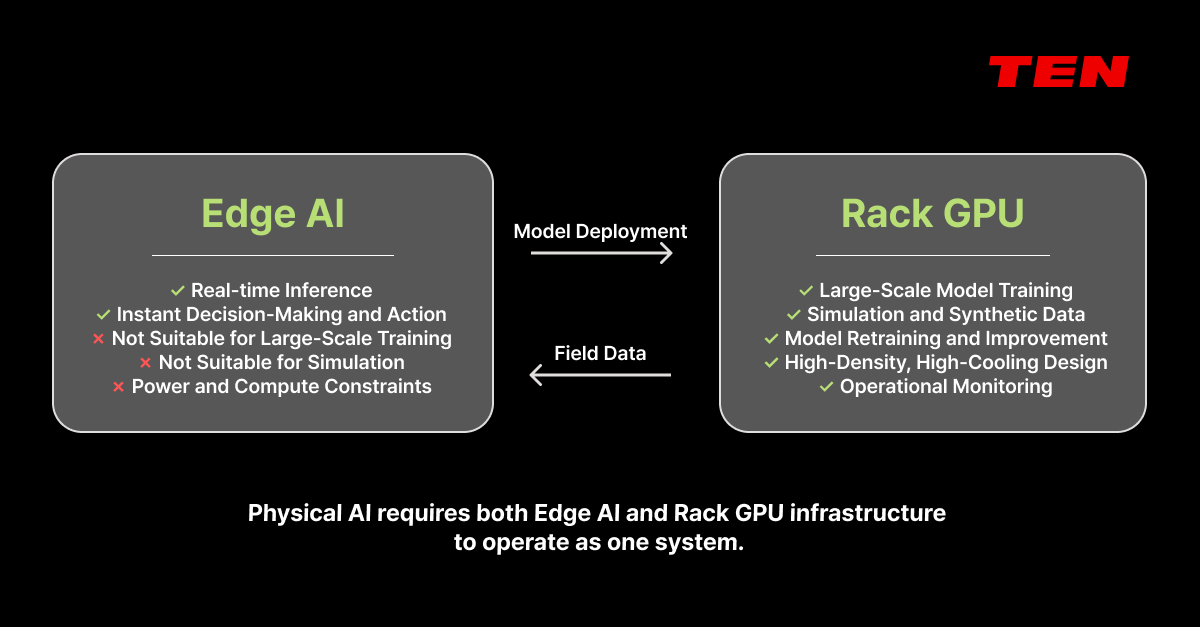
Because Physical AI operates in real-world environments, Edge AI plays a critical role.
Edge AI refers to a method of performing AI computation close to where data is generated, such as on robots, autonomous vehicles, or industrial machines, rather than sending all data to a central cloud or data center.
Robots and autonomous systems must make decisions and move immediately in the field. When a robot needs to stop or change direction during a task, when an autonomous vehicle needs to respond to an unexpected road situation, or when factory automation equipment needs to detect abnormal signals, latency becomes extremely important.
Sending all data to the cloud or a central data center and then waiting for a response can increase latency, making that approach unsuitable for many real-time Physical AI applications. This is why Edge AI is essential for Physical AI systems that require immediate decision-making in the field.
However, not every Physical AI challenge can be solved at the edge.
Edge devices are located close to the field and can provide fast responses, but they are also constrained by power, heat, size, memory, and computing performance. Unlike central servers, edge devices must operate within the limited space and power capacity of robots or machines. This also limits the size and complexity of the models that can be deployed on them.
As a result, large-scale model training, complex physics simulation, large-scale synthetic data generation, and repeated model retraining are difficult to handle entirely on edge devices.
Physical AI Data Loop
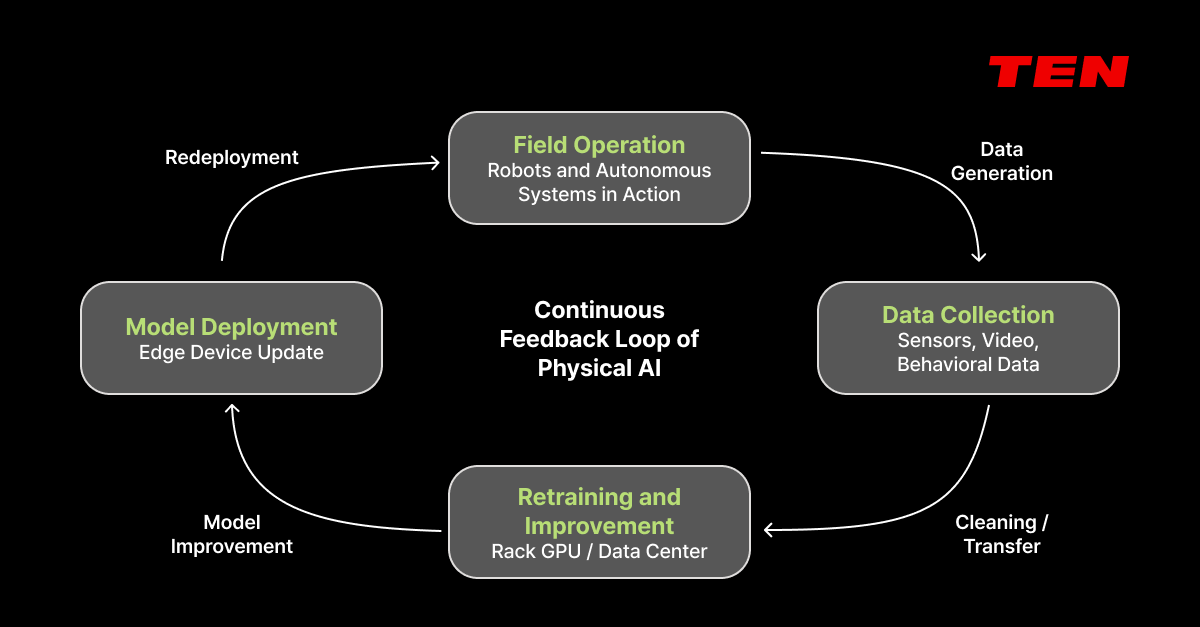
Physical AI is not just about performing inference in the field. Before being deployed, robots and autonomous systems must learn and validate many different scenarios in virtual environments, including risky work conditions, rare failure cases, and unusual object movements.
Even after deployment, data processing continues. Robots and autonomous systems constantly generate new data during real-world operation. This data must be collected, cleaned, and used for model retraining and performance improvement. In other words, Physical AI is not a one-time training process. It is a continuous cycle of field data collection and model improvement.
This process requires separate high-performance infrastructure for continuous data processing and retraining.
To handle large-scale training and simulation, companies need more than a single device. They need GPU clusters where multiple GPU servers are connected through high-speed networks. They also need sufficient power supply, cooling design, rack-level operation management, and monitoring systems to run high-density GPU servers reliably.
Therefore, the core infrastructure strategy for Physical AI is not to process everything at the edge. Instead, edge devices should handle immediate decision-making and execution in the field, while rack-scale GPU infrastructure supports training, simulation, synthetic data generation, and model retraining.
How Should Companies Prepare Physical AI Infrastructure?
So how should companies prepare for Physical AI infrastructure?
Companies considering Physical AI adoption first need to ask the following questions.
Which part of our Physical AI workload creates the greatest burden: training, simulation, or inference?
What GPU configuration do we need, and can our current infrastructure support it?
Do we have the power and cooling structure required to operate high-density GPU servers?
These questions cannot be solved simply by purchasing hardware. Physical AI infrastructure must be designed based on workload characteristics. Training-oriented infrastructure, simulation-oriented infrastructure, and edge inference-oriented infrastructure each require different GPU configurations, network architecture, storage capacity, and cooling methods.
Therefore, the infrastructure strategy for the Physical AI era must shift from “how many GPUs should we secure?” to “what workloads should we run, in what structure, and how efficiently?”
TEN’s Focus: AI Infrastructure Design for Physical AI
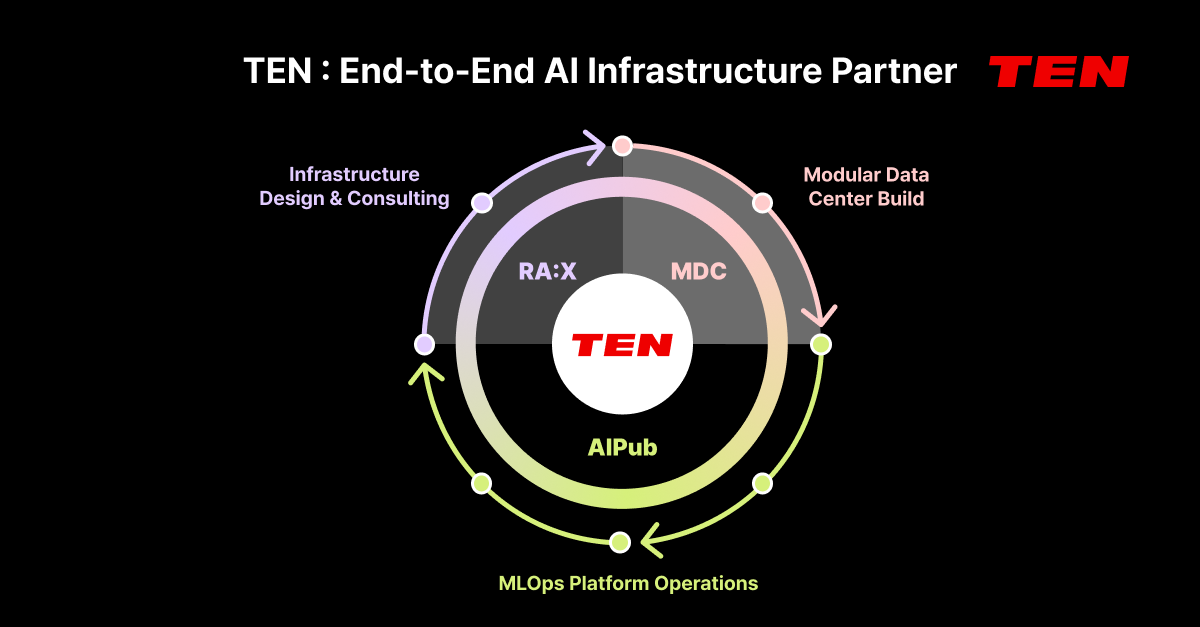
TEN supports companies as an infrastructure partner for the Physical AI era in three key ways.
RA:X — Consulting That Starts with Infrastructure Design
In Physical AI environments, the requirements for training, simulation, and inference differ at each stage. Buying hardware first and then trying to configure it later can easily lead to overinvestment and operational inefficiency.
TEN’s RA:X proposes the optimal hardware and infrastructure configuration based on the customer’s AI model, real data samples, and performance metrics. From GPU selection and network configuration to cooling methods and power design, RA:X designs infrastructure based on real workloads so that the infrastructure can operate effectively even after deployment.
For companies considering Physical AI infrastructure for the first time, starting with RA:X consulting before purchasing hardware can be a practical way to reduce total cost of ownership.
TEN MDC — A Modular Data Center for High-Density AI Servers
Physical AI infrastructure must support large-scale GPU training and simulation, which makes power, cooling, and scalability critical.
GPU generations change every 18 to 24 months, and AI workload requirements change along with them. However, traditional data centers often take more than two years to build and are difficult to modify once constructed. This makes it difficult for conventional data center approaches to keep up with the rapidly changing infrastructure requirements of Physical AI.
TEN MDC addresses these limitations through a modular structure. It designs server rooms, UPS rooms, and cooling facilities as independent modules and assembles them on-site using a pre-fab approach. This can shorten the construction period, and when GPU demand or cooling requirements change, specific modules can be added or replaced.
Operational efficiency after deployment is also important. Through TEN MDC’s integrated monitoring dashboard, companies can check power supply status, temperature and humidity, and GPU and CPU utilization in real time. This helps detect issues in advance and build an operating system that improves GPU utilization and infrastructure stability.
AI Pub — A Platform That Connects Training and Operation
In Physical AI environments, continuous data collection, retraining, deployment, and monitoring are required even after model development.
AI Pub is an MLOps platform that systematizes this operational process, supporting GPU utilization optimization and integrated workload management.
AI Pub can divide a single GPU into up to 100 blocks, allowing multiple workloads to share resources reliably. It also automatically allocates and schedules resources according to training and inference workloads. In addition, it supports an RBAC structure that integrates access control for GPU nodes, storage volumes, and image hubs by team, project, and role.
AI Pub Helper, powered by LLMs, analyzes logs across the entire infrastructure in real time, diagnoses the cause of failures, and suggests response actions. Instead of requiring operators to manually search through logs, the system can detect abnormal signals earlier and support faster response.
TEN supports the full infrastructure flow required for Physical AI to operate in real industrial environments: design through RA:X, deployment through MDC, and operation through AI Pub. Each component can be used independently, but when the three are connected, they can improve both the deployment efficiency and operational stability of Physical AI infrastructure.
Conclusion: In the Physical AI Era, Infrastructure Readiness Becomes a Competitive Advantage
Physical AI is still an early-stage market. However, the direction of the U.S. market is clear.
NVIDIA is rapidly expanding its models, simulation tools, data generation systems, and edge inference platforms for Physical AI. The U.S. government views AI and robotics as core technologies for manufacturing, logistics, defense, and national competitiveness. The market outlook also points to significant growth potential.
The essence of this shift is not just the advancement of robot hardware. For AI to operate in the real world, training, simulation, inference, power, cooling, and operational platforms must all be prepared together.
The key question is no longer, “Should we adopt Physical AI?”
It is now, “How should we prepare the infrastructure needed to operate Physical AI?”
In the Physical AI era, competitiveness may begin with the model, but real-world industrial performance will likely be determined by infrastructure.
If you are considering Physical AI infrastructure, start with RA:X consulting.
👉 Learn more about TEN RA:X : https://ten1010.io/products/rax
👉 Learn more about TEN MDC: https://ten1010.io/blog/modular-data-center-mdc-ai-infrastructure
👉 Learn more about AI Pub: https://ten1010.io/blog/ai-pub-gpu-scheduling-ai-workload-automation
📩 Contact our experts directly: https://ten1010.io/inquiry