


What Is a Modular Data Center (MDC)? The Next-Generation Approach to Building AI Infrastructure
June 5, 2026
Introduction: How AI Is Changing the Standards for Data Centers
The rise of generative AI and large language models is fundamentally changing the role of data centers.
In the past, data centers were mostly understood as facilities designed to reliably house servers and network equipment. Today, however, as AI continues to advance, data centers have become far more complex. They now need to account for GPU server power consumption, heat generation, rack density, cooling architecture, and operational efficiency all at once.
AI competition is no longer only about model performance. For companies to apply AI to real services and business operations, they need high-performance GPU servers, high-speed networking, large-scale storage, stable power supply, efficient cooling systems, and data center infrastructure that can operate all of these components as one integrated system.
In other words, data centers in the AI era are evolving from “spaces that house servers” into “strategic infrastructure that enables organizations to operate AI reliably and cost-effectively.”
Why AI Infrastructure Is Straining Traditional Data Centers
GPU-Based AI Infrastructure Requires More Power and More Cooling
The biggest shift in AI infrastructure is the rapid advancement of GPU servers.
As AI models become larger, they require more computing resources. To support these workloads, organizations increasingly rely on high-performance GPU servers. But as GPU performance increases, power consumption also rises, and so does the amount of heat generated by each server.
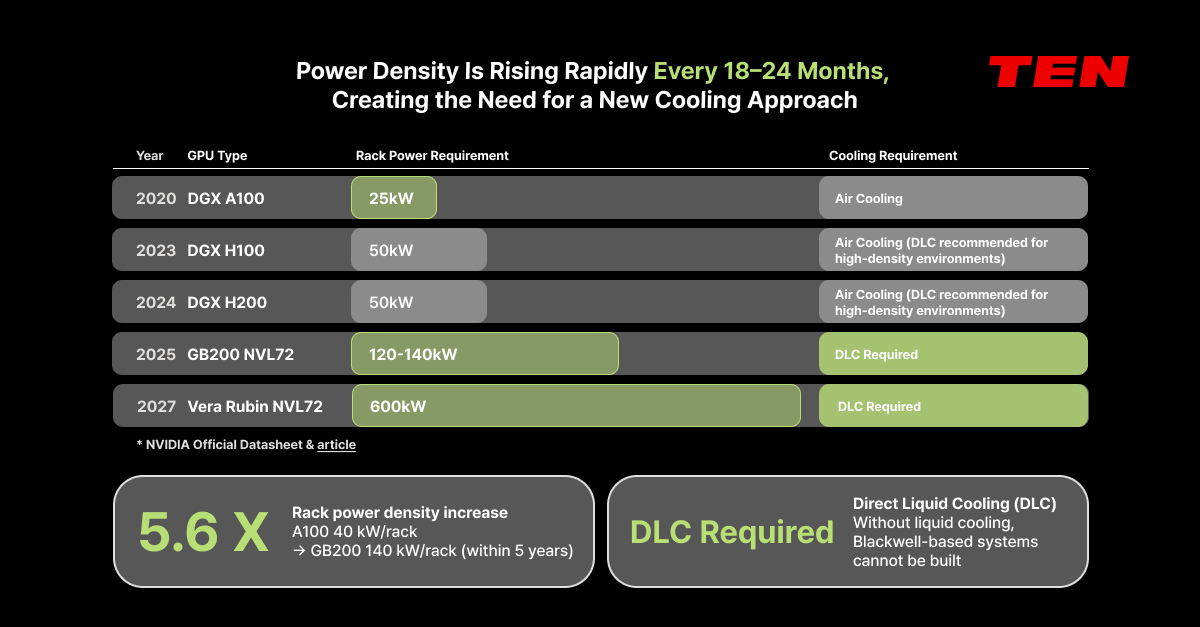
In particular, rack power density is increasing rapidly in today’s AI infrastructure environment. Every 18 to 24 months, power density rises sharply, and new cooling approaches emerge in response. This trend is forcing conventional data centers to rethink their infrastructure from the ground up.
For example, in an A100-based AI infrastructure environment, rack power density was around 25kW per rack. In a GB200-based environment, that figure can rise to approximately 140kW per rack. That means rack-level power requirements have increased by roughly 5.6 times over the past five years.
At this level of power density, it becomes difficult to operate high-density GPU servers reliably with the power distribution structures and cooling methods used in conventional data centers.
Cooling approaches are changing just as fast. In the past, air cooling was sufficient for many workloads. But as high-density GPU servers become more common, more environments are reaching a point where air cooling alone can no longer handle the heat.
Next-generation systems like NVIDIA’s Blackwell architecture are increasingly designed around Direct Liquid Cooling (DLC), making liquid cooling not just an option, but a requirement.
This means AI data centers can no longer be designed by first creating a server room and then fitting the cooling system around it. Instead, GPU power density and cooling requirements must become the starting point of the design.
The Limits of Conventional Data Centers: Why the Old Approach Is No Longer Enough
TCO Management Is the Real Metric in AI Infrastructure
When building AI infrastructure, the initial construction cost is only one part of the equation. Organizations need to evaluate the full Total Cost of Ownership (TCO): GPU procurement, power and cooling expenses, staffing, maintenance, and the cost of idle assets, all added together.
Even if a company secures high-performance GPUs, the overall cost burden can rise sharply if the data center is not ready to operate them, or if power and cooling costs become excessive during operation.
Limitation 1 — Data Center Construction Takes Longer Than GPU Generation Cycles
One of the most pressing limitations of conventional data centers is how long they take to build.
A typical large-scale facility requires site acquisition, permitting, architectural design, power infrastructure, cooling systems, equipment installation, and testing — all before a single workload runs. For large-scale data centers, additional variables such as local community complaints, permitting delays, and power supply negotiations can extend the timeline far beyond the original plan.
These delays create an even bigger problem in AI infrastructure because AI servers and GPU generations change quickly. GPU generations turn over every 18 to 24 months, and new server architectures and cooling methods continue to emerge. As a result, infrastructure that was appropriate at the design stage may already be outdated by the time the data center is completed.
This is not hypothetical. One TEN customer experienced a similar issue.
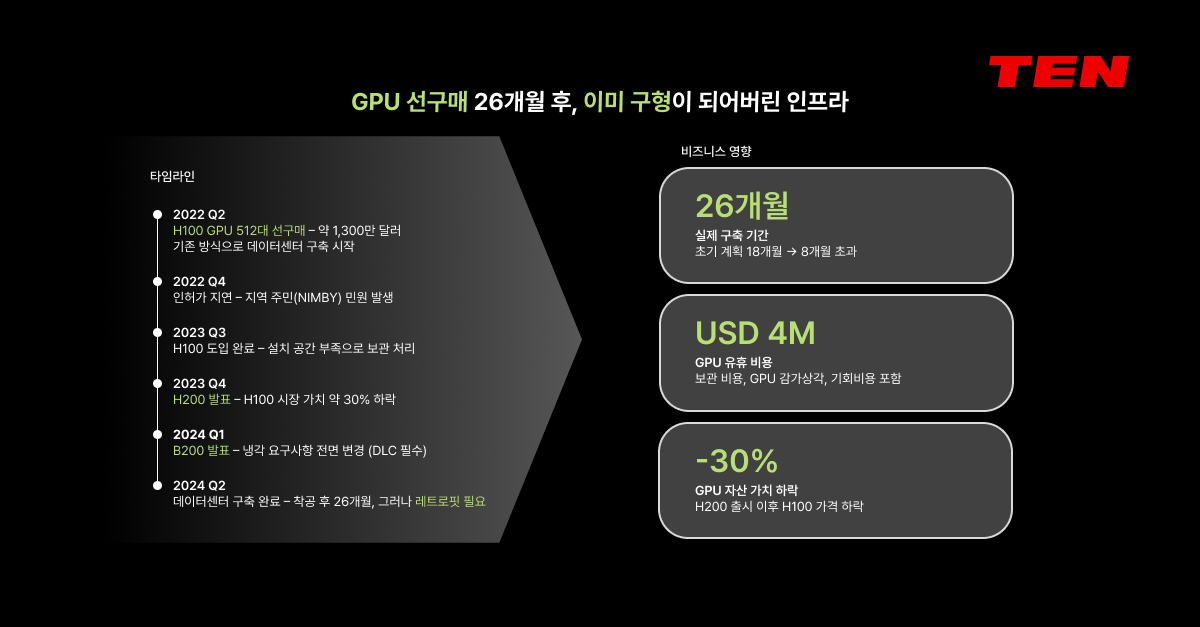
The customer pre-purchased 512 H100 GPUs and began building a data center using a conventional approach. However, permitting delays and local community concerns extended the construction period to 26 months, which was eight months longer than the original plan.
During this period, the high-value GPUs could not be installed and remained idle. TThe carrying costs — storage, depreciation, and opportunity cost — were estimated at approximately USD 4 million. In addition, after the release of H200, the price of H100 dropped by around 30%, resulting in a loss of asset value.
Limitation 2 — Structural Changes Are Difficult After Completion
Another limitation of conventional data centers is structural rigidity.
Once a data center has been completed, it is difficult to modify the structure later, even when requirements change. For example, if a data center was originally designed around air cooling, introducing liquid-cooled GPU servers afterward is not as simple as adding new cooling equipment.
It may require new coolant piping, changes to the power distribution structure, and a redesigned rack layout. In some cases, operations may need to be partially interrupted, while additional construction costs and equipment replacement costs must also be absorbed.
In a field like AI infrastructure, where technology changes quickly, this kind of structural rigidity becomes a major risk.
The real competitive question for AI data centers is not “How large should we build?” It is “How quickly can we deploy, how flexibly can we scale, and how efficiently can we operate?” That is what actually determines infrastructure advantage.
This is the problem that Modular Data Centers (MDCs) are designed to solve.
What Is a Modular Data Center (MDC)?
The Core Concept: A Data Center Built by Assembling Modules
A Modular Data Center(MDC) is a data center deployment model in which the facility is designed and assembled in functional module units.
Where a conventional data center is a single large structure built from the ground up, an MDC organizes distinct functions, such as compute rooms, UPS rooms, battery storage, common areas, and cooling infrastructure, into independent modules that can be connected and expanded depending on the required scale and purpose.
The key point is that organizations do not have to build the entire capacity all at once from the beginning. Infrastructure can be expanded as demand grows, making MDCs especially suitable for AI infrastructure environments where demand changes quickly and technology cycles are short.
MDC vs. Containerized Data Centers: Not the Same Thing
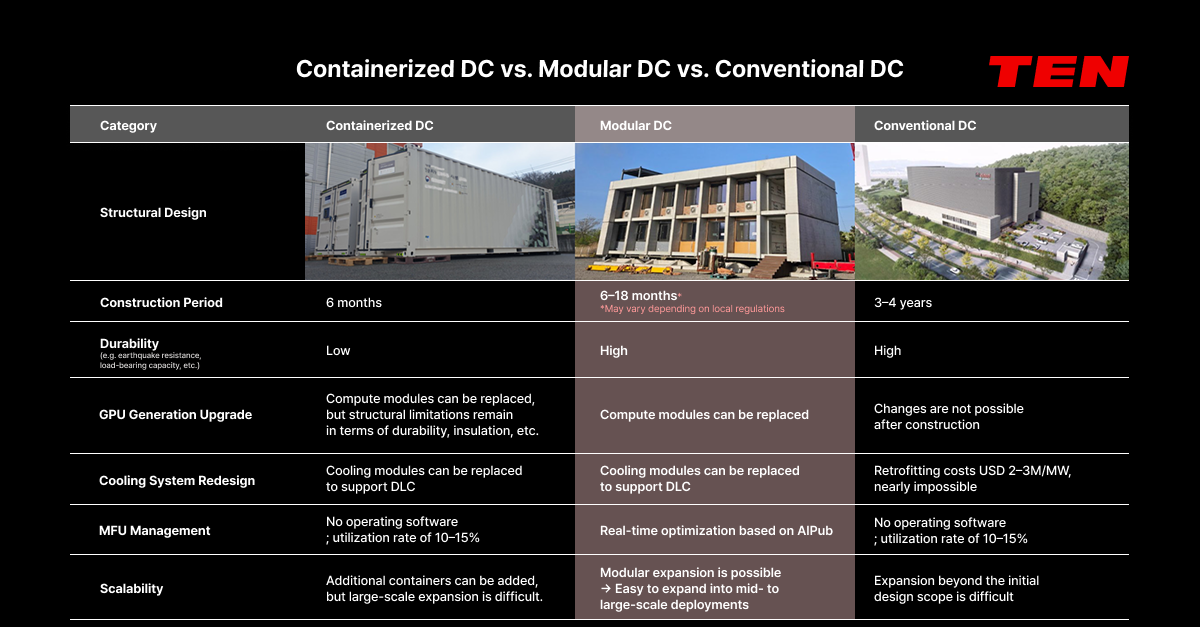
MDCs are often confused with containerized data centers, but the two are meaningfully different.
Containerized data centers use steel shipping containers as their structural base. Fast to deploy — but limited in fire resistance, insulation, load capacity, and enterprise-scale expandability.
MDCs, by contrast, use concrete-based modular construction to improve durability, scalability, and the ability to accommodate high-density servers. It maintains a level of structural stability comparable to conventional building-type data centers, while offering better scalability and faster deployment than containerized structures.
AI data centers need to integrate many infrastructure elements from the beginning, including high-density GPU servers, high-power racks, liquid cooling, UPS systems, batteries, and coolant piping. For long-term AI infrastructure demand, a simple container-based space may not be enough.
The Advantages of Modular Data Centers
1. Faster Deployment Through a Pre-Fab Approach
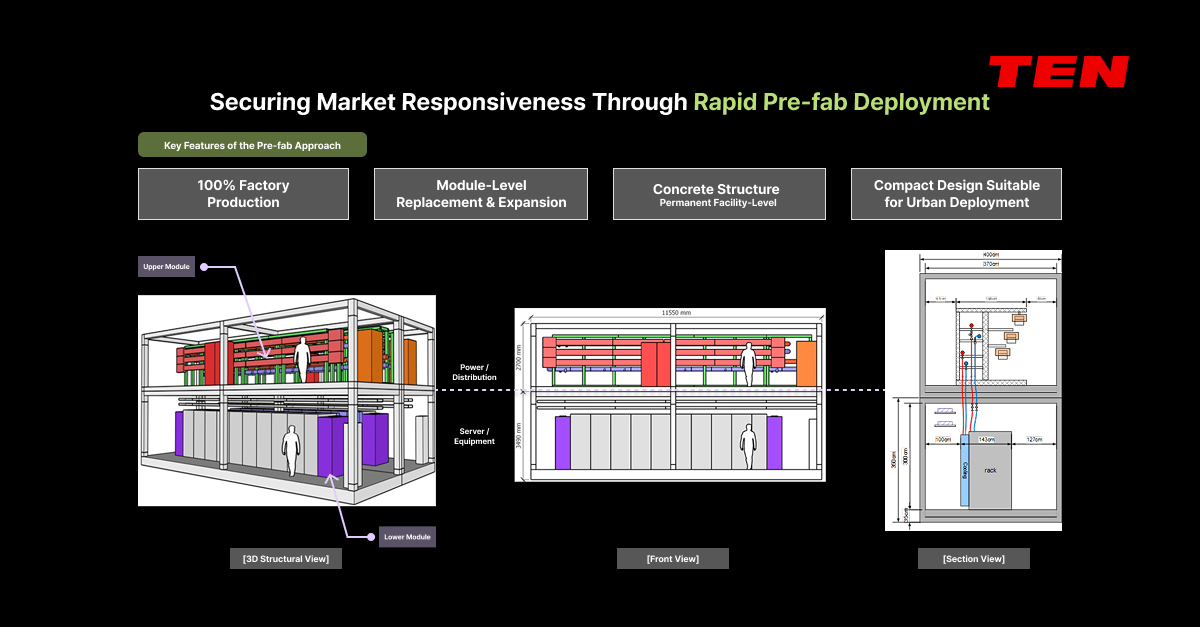
MDC modules are manufactured in a factory, then assembled on-site. This compresses timelines, standardizes quality, and shortens the path from decision to deployment.
In AI infrastructure, where fast market response is critical, deployment speed becomes a direct competitive advantage.
2. Flexible Structural Reconfiguration to Keep Pace with GPU Generation Changes
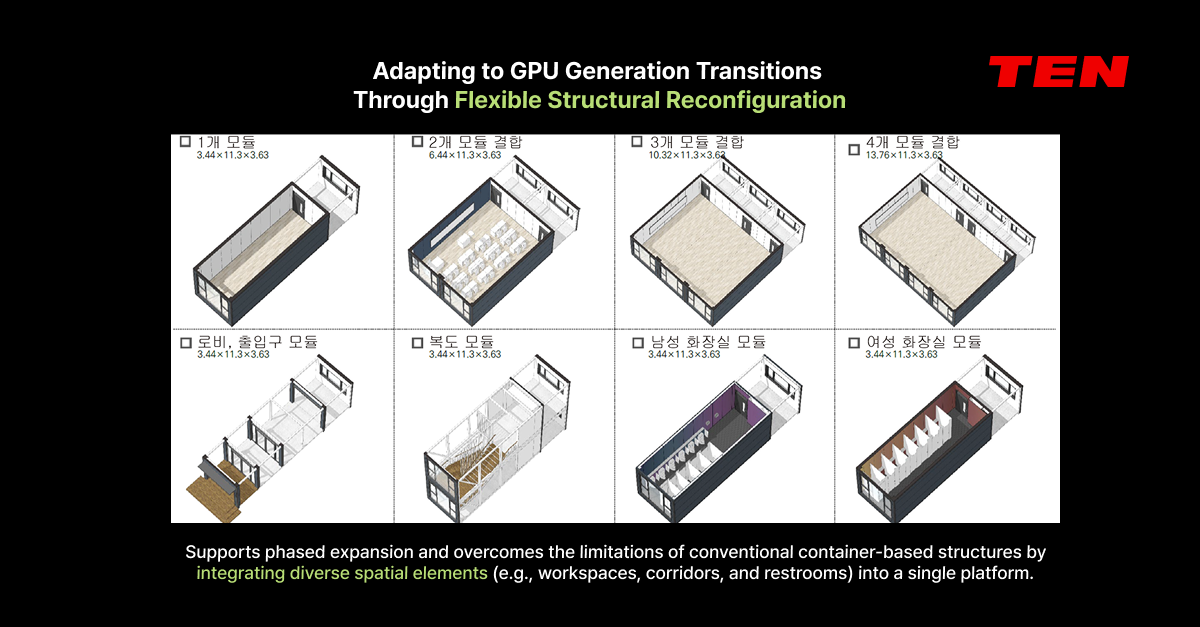
MDCs allow specific functional modules to be added or replaced as needed.
If demand for GPU servers increases, additional IT room modules can be added. If power requirements rise, UPS or battery modules can be expanded. If cooling requirements change, the module configuration can be adjusted to reflect the necessary cooling equipment and piping structure.
That kind of structural flexibility is essential in a technology environment that changes as fast as AI does.
3. Structural Design for High-Density AI Servers
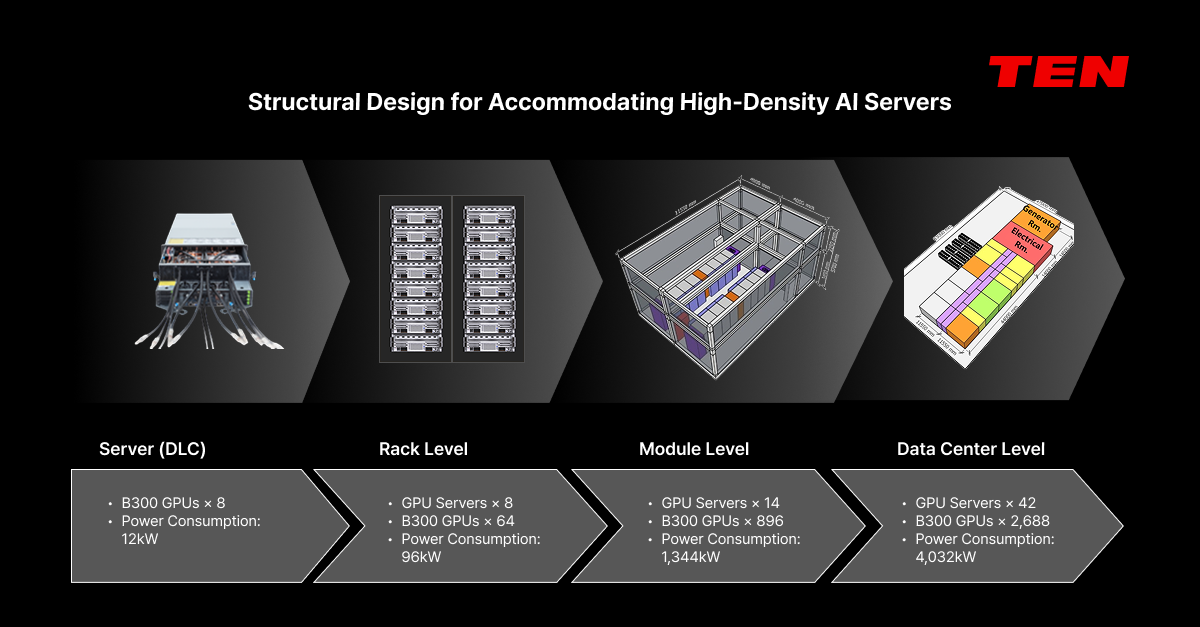
AI servers require far more power and cooling than general-purpose servers.
MDCs can be designed from the beginning with the infrastructure required to operate high-density GPU servers, including DLC, CDU, RDHx, and BUS Way power distribution. Unlike conventional data centers designed primarily around air cooling, MDCs can structurally support next-generation AI server environments.
4. Lower Initial Investment Risk and Reduced TCO Through Phased Expansion
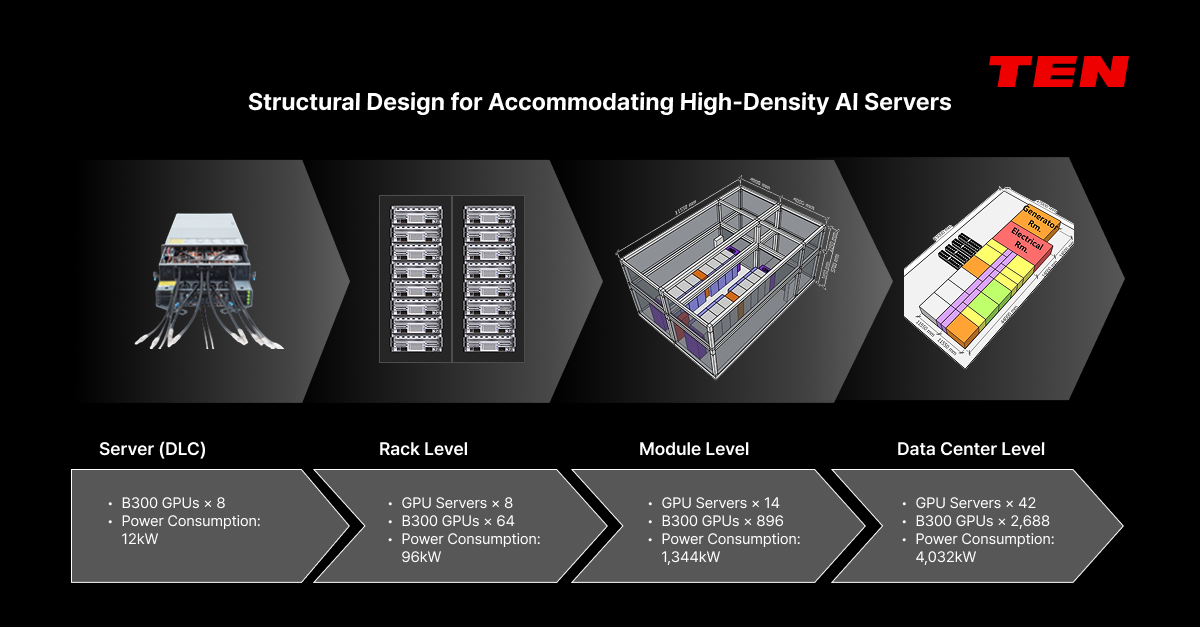
Conventional data centers require large-scale investment from the beginning. MDCs, however, allow organizations to add modules gradually in line with demand. This reduces the burden of initial CapEx and improves capital efficiency.
AI infrastructure is capital-intensive across GPUs, storage, networking, power systems, and cooling systems. Because MDCs allow organizations to build only what they need first and expand later as demand grows, they can reduce the likelihood of idle assets and help lower overall TCO.
5. Improved Efficiency Through Integrated Operating Software
How a data center is run matters as much as how it's built.
Low GPU utilization wastes expensive hardware. Slow fault detection hurts service reliability. This makes post-deployment operations and management systems critical for AI data centers.
MDCs can be combined with DCIM(Data Center Infrastructure Management) to support compute node configuration management, utilization monitoring, health checks, and integrated management of clusters and workloads.
What Makes TEN’s MDC Different?
Conventional data centers are built to house servers, then fitted with equipment. TEN MDC works the other way around.
The design starts with the customer’s AI workloads. From there, the right servers, storage, networking, power, cooling, and software are determined. The data center is designed around the AI infrastructure, not the other way around.
Flexible Infrastructure Configuration for Various AI Accelerators and Equipment
TEN MDC is designed on the assumption that it will operate high-performance AI infrastructure.
Internally, it supports a wide range of hardware: NVIDIA DGX H100, A100, and GPU accelerators from multiple vendors, alongside high-capacity storage and high-speed networking. The configuration is determined by the customer’s workloads, goals, budget, and growth plans.
This means TEN MDC is not a fixed structure designed for a single vendor or a specific type of equipment. Instead, the infrastructure configuration can be adjusted according to the customer’s AI workload, deployment purpose, budget, and expansion plan.
In this sense, TEN MDC is not simply a space for placing servers. It is a flexible AI infrastructure platform that allows different AI accelerators and infrastructure equipment to be combined according to each customer’s needs.
Integrated Monitoring Dashboard for Operational Visibility
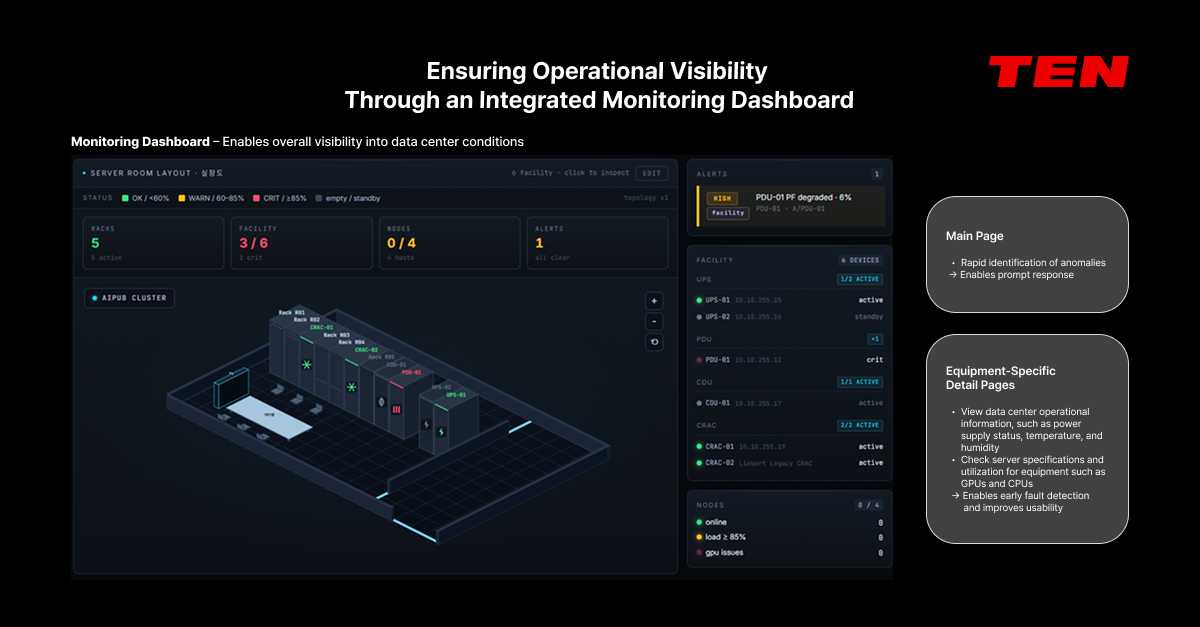
Another key differentiator of TEN MDC is its operational management system.
In AI data centers, operational efficiency after deployment is extremely important. Low GPU utilization wastes expensive infrastructure, while delayed detection of equipment issues can affect service stability.
TEN’s MDC monitoring dashboard helps operators understand the overall status of the data center at a glance. From the main page, operators can quickly identify equipment that requires immediate attention, allowing them to detect issues and respond promptly when abnormalities occur.
Equipment-specific detail pages provide not only the overall infrastructure status, but also key information needed for data center management, such as power supply status, temperature, and humidity. They also display real-time graphs of server utilization, including GPU and CPU usage. This enables early fault detection and helps improve GPU utilization.
AI Infrastructure Optimization Through AI Pub and RA:X
Provisioning a data center is only part of the challenge.
Before deploying hardware, organizations need to answer harder questions: What AI models will run here? How much GPU capacity is needed? What networking and storage architecture is right? Which cooling approach fits the workloads?
TEN addresses this with two tools.
AI Pub is a software platform for AI development and operations. It focuses on maximizing infrastructure utilization across the full workload lifecycle.
RA:X is TEN's AI infrastructure consulting service. Using a customer's actual models, data samples, and performance benchmarks, RA:X delivers specific hardware and infrastructure recommendations — before any capital is committed.
Combined with TEN MDC, these capabilities change the question from "what kind of building should we construct?" to "what AI workloads do we need to run, and what's the most efficient way to run them?" That's a more valuable starting point for any infrastructure decision.
Who Is MDC Best Suited For?
MDCs are especially suitable for companies and institutions in the following situations.
Companies Building AI Model Training Infrastructure
Companies training large-scale AI models need high-performance GPU clusters, high-speed networks, and high-density cooling environments. TEN MDC can support these needs through an integrated design approach that connects the server level to the data center level.
Companies Operating AI Inference Services
Once AI services are commercialized, stable inference infrastructure becomes essential. As usage grows, the ability to expand quickly becomes especially important. Modular data centers allow capacity to be increased gradually in line with demand.
Companies That Have Secured GPUs but Lack Operating Space
Some companies pre-purchase GPUs but later find that their existing data center environment cannot accommodate them. Power, cooling, and rack density limitations can leave GPUs idle. In this situation, TEN MDC can provide an alternative through fast deployment and AI server-centered design.
Institutions Considering Their Own AI Data Centers
Public institutions, research institutions, large enterprises, and AI service companies that are considering their own AI data centers need to evaluate TCO and scalability from the initial design stage. TEN MDC can support this decision-making process through a Reference Architecture-based approach.
Conclusion: The Core of AI Data Centers Is Not Just Fast Deployment, but Flexible Evolution
GPU generations are changing quickly. Rack power density continues to rise. Cooling is shifting from air cooling to liquid cooling. In this environment, conventional fixed data center deployment models are showing clear limits in both speed and flexibility.
MDCs offer a practical alternative to these limitations. Modules can be manufactured in factories, assembled on site, expanded according to demand, and structurally adjusted to meet new AI infrastructure requirements.
For organizations serious about AI as a business capability, the data center is no longer an overhead line item. It's a competitive differentiator.
The questions that matter aren't just "which GPUs should we buy?" They extend to: Where will those GPUs be deployed? What power and cooling architecture supports them? And how do we manage total cost of ownership over the full lifecycle?
MDC is TEN's answer — a foundation for AI infrastructure that evolves as fast as the technology it runs.