


AI Is Playing in the World Cup Too: What the 2026 FIFA World Cup Tells Us About the Future of AI Agents
June 8, 2026
The World Cup Is Almost Here
The 2026 FIFA World Cup kicks off on June 11.
This year’s tournament will be co-hosted by the United States, Canada, and Mexico. It will also be the largest World Cup in history, with 48 teams participating for the first time. With 104 matches on the schedule, there's more football than ever for fans around the world to enjoy.
But this World Cup will not only be about the players on the pitch.
At the 2026 FIFA World Cup, AI will also take the stage.
Meet the World's First AI Coach: What Is Football AI Pro?
Ahead of the tournament, FIFA and Lenovo introduced a series of AI-powered technologies at CES 2026, including Football AI Pro, AI-based 3D player avatars, and next-generation referee-view broadcasting.
[Source: FIFA, Lenovo, 2026.01]
Among them, the standout is Football AI Pro.
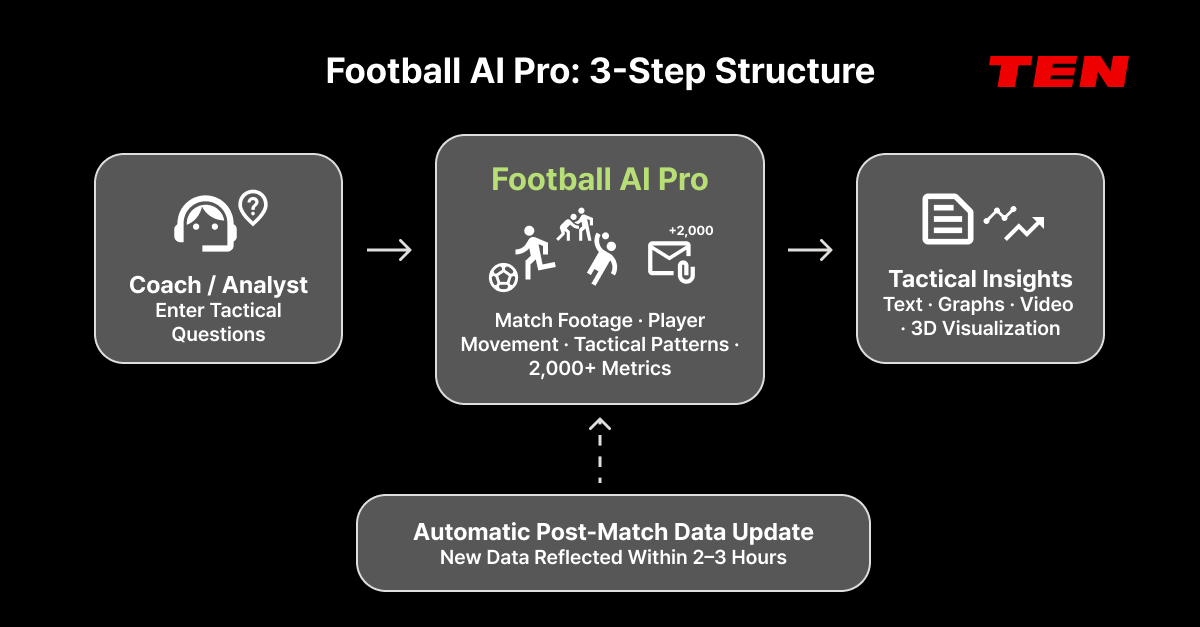
Football AI Pro is an AI-powered analysis tool designed to provide coaches, players, and analysts with tactical insights. It is trained on FIFA’s exclusive match footage, millions of data points, and more than 2,000 advanced performance metrics. In simple terms, it is like an AI analysis partner built specifically for football. The tool is expected to be provided free of charge to all 48 teams participating in the tournament.
For example, a coach or analyst could ask, “What is the most effective route to break through the opponent’s defense?” or “How should we respond if the opponent changes tactics in the second half?”
The AI can then analyze match data, player movements, tactical patterns, and video footage to generate answers. It can support not only text-based responses, but also graphs, video clips, and 3D visualizations, helping teams make tactical decisions faster and more efficiently.
After each match, new game data is updated into the AI engine. As the tournament progresses, the AI can continue learning each team’s latest tactical trends and become more refined.
AI Coaches Could Level the Playing Field
One of the most interesting aspects of Football AI Pro is its potential to level the playing field in football analysis.
Football powerhouses such as France and Brazil already have large teams of performance analysts and data scientists. Smaller teams, including countries making their first-ever World Cup appearance such as Curaçao and Cape Verde, may not have the same level of analytical resources.
But if every team can use the same AI analysis tool, the situation changes.
With Football AI Pro, teams without large analytics departments may still be able to understand their opponents’ tactical patterns, player movements, and match flow in much greater detail. In this sense, AI could help narrow part of the analysis gap between football giants and underdogs.
Of course, AI will not erase all differences in performance. How the data is interpreted, which tactical decisions are made, and how those decisions are executed on the pitch will still depend on humans.
But this is the first World Cup where every team goes in with the same AI analyst on the bench.
AI Is Changing How We Watch Football Too
AI will not only be used for tactical analysis. It is also expected to transform broadcasting and the fan experience during the tournament.
As FIFA’s official technology partner, Lenovo will install servers at the International Broadcast Center in Dallas and deploy more than 200 engineers and over 17,000 devices across stadiums and team training facilities. Its technology will reduce IPTV latency to under five seconds, allowing more than 1,000 screens across FIFA venues to display matches almost in real time. 3D player avatars will make offside calls easier to visualize, and AI-stabilized referee-view cameras will give six billion fans a new angle on the game.
[Source: Lenovo Newsroom, 2026.06]
In Korea, KBS will also broadcast 91 of the 104 World Cup matches exclusively on terrestrial television. This year, they're introducing AI-powered match prediction, a tactical simulation feature called "Tactics Note," and an AI chatbot — giving viewers richer, more intuitive coverage than ever before.
Sports broadcasting is moving beyond simply transmitting the match. AI is now helping analyze the flow of the game and provide viewers with more intuitive information.
AI Agents: From Sports to Every Industry
It would be a mistake to see the AI used in this World Cupas just "cool tech."
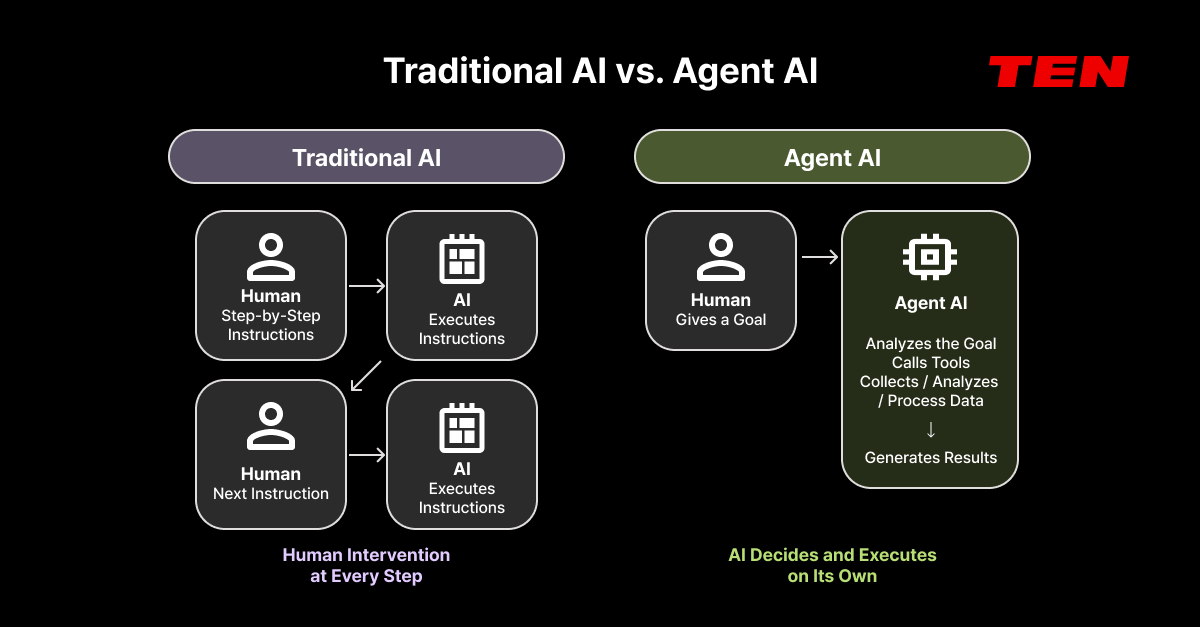
If we look closely at Football AI Pro, it is not simply a tool that searches and displays data. When it receives a question, it identifies relevant data, analyzes video, draws tactical conclusions, and generates 3D visualizations. After a match ends, it can also reflect new data back into its system.
This is how Agentic AI works.Instead of waiting for humans to give step-by-step instructions, an AI Agent receives a goal, calls the tools it needs, processes data, and produces results.
AI Agents are already spreading quickly across many industries. In healthcare, they are being used for patient data analysis and diagnostic support. In finance, they are supporting risk analysis and report generation. In manufacturing, they are being used for quality inspection and equipment anomaly detection. In media, they are expanding into automatic editing, highlight generation, and personalized content recommendation.
The World Cup is a symbolic example of how AI Agents can be used on a global stage watched by people around the world.
AI is no longer living inside a handful of companies' internal experiments. It's spreading into our everyday lives — in the services we use, the tools we work with, and the decisions that affect us.
And as that happens, the question companies need to answer is changing too.
So How Do You Actually Run AI Agents?
Adopting AI agents isn't just a technology decision. The real challenge is operations.
AI agents are fundamentally more complex to run than conventional AI tools. A standard AI system waits for someone to submit a task. But AI Agents can call the tools they need and execute multiple tasks in sequence to achieve a goal.
This creates three recurring challenges.
1. Resource usage is unpredictable.
It's hard to know in advance when an agent will need GPU compute or how much. When multiple agents run simultaneously, resource contention and queuing delays become real issues.
2. Security boundaries get complicated.
Agents can autonomously access databases, external APIs, file systems, and other agents. Without clear access controls, that autonomy becomes a security risk.
3. Cost tracking breaks down.
When agents spawn sub-tasks and call multiple models, it becomes difficult to attribute compute spend to specific teams, projects, or workloads.
Running Agentic AI reliably at scale requires more than a good model. It requires the infrastructure and operational framework to manage what the model does once it's deployed.
The Answer Is AI Orchestration
This is where AI orchestration becomes essential.
AI orchestration is a unified operational layer that manages resource allocation, access control, monitoring, and cost tracking across multiple AI agents and workloads, so they can all run on the same infrastructure without conflict.
In football terms, if a coach assigns player positions and coordinates tactics, an AI orchestration platform coordinates how much GPU resource each agent receives, which team can access which data, and where operational issues are occurring.
As the number of agents increases, and as they perform more complex tasks autonomously, orchestration becomes a core capability for AI operations.
TEN AI Pub: An Orchestration Platform for AI Agent Operations
TEN provides the infrastructure and platform that AI agents need to operate reliably in real-world environments.
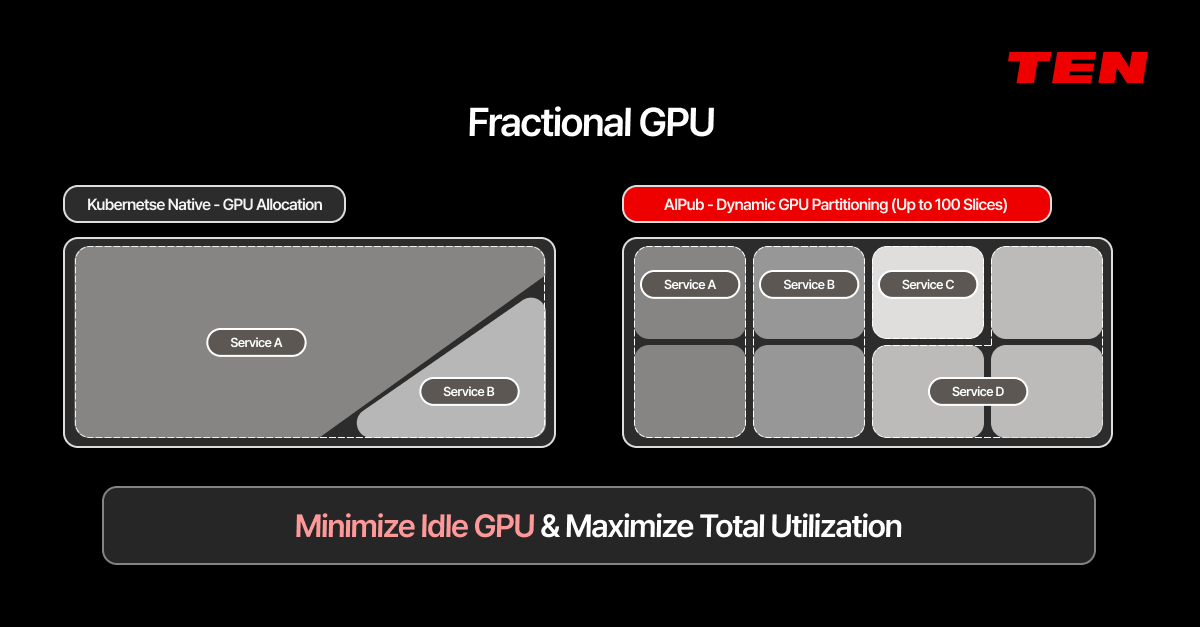
AI Pub supports GPU resource partitioning and automatic scheduling, allowing multiple workloads to run stably within the same infrastructure. A single GPU can be divided into up to 100 blocks, enabling multiple agents to share resources without conflict.
AI Pub also automatically allocates resources according to the characteristics of training and inference workloads, helping improve GPU utilization.
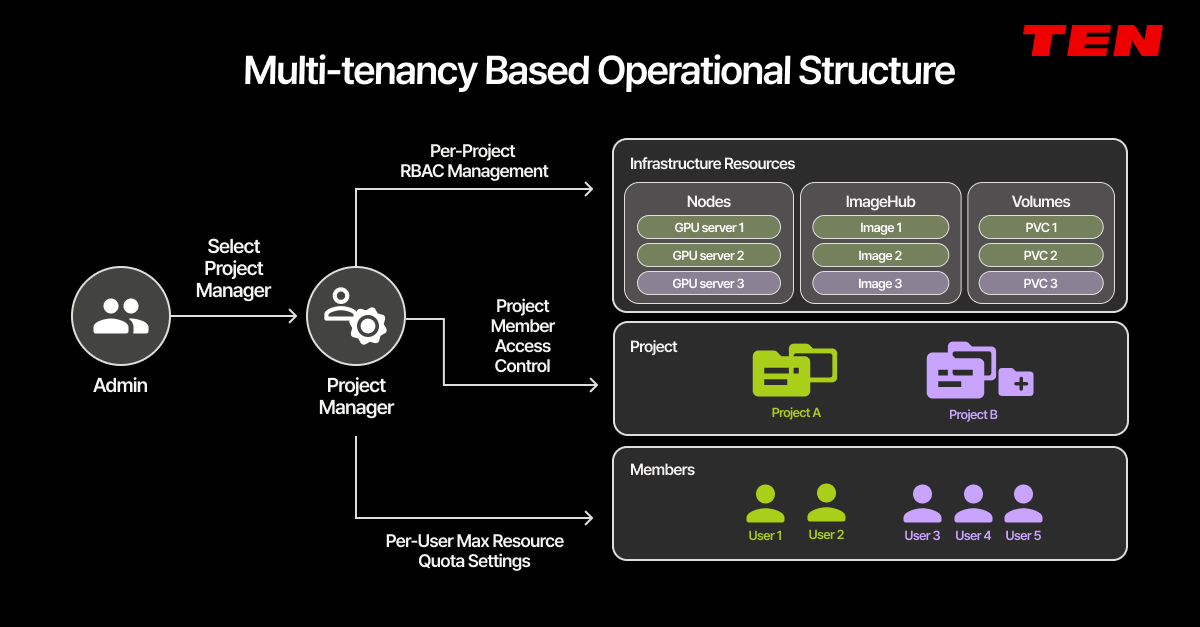
AI Pub also supports an Role-based access control (RBAC) structure that controls access to GPU nodes, storage volumes, and image hubs by team, project, and role. This is especially important when multiple teams are developing and operating AI Agents at the same time.
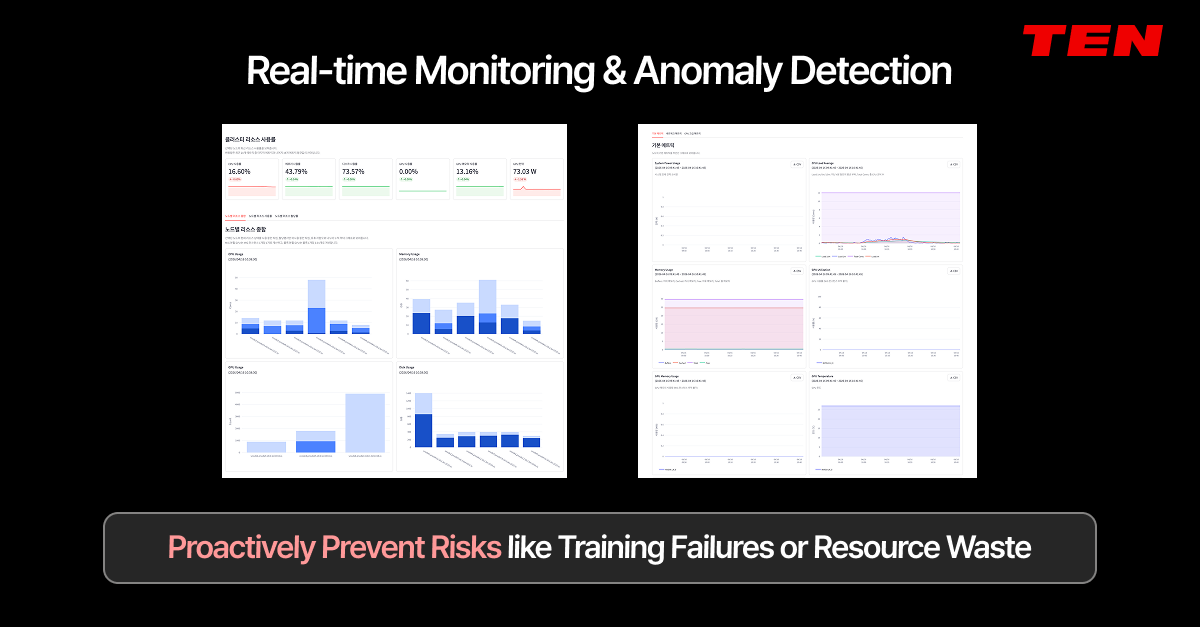
AI Pub Helper analyzes logs across the entire infrastructure in real time, diagnoses the cause of failures, and suggests response actions. Instead of requiring people to manually review every log, AI can detect abnormal signals earlier and help teams respond faster.
TEN goes beyond simply providing GPU resources. It provides an orchestration environment where AI Agents can operate reliably.
In Football and in AI, the Prepared Team Wins
The 2026 FIFA World Cup will be more than just a football tournament. It will be a global showcase where AI enters sports tactics, broadcasting, operations, and fan experience at scale.
AI will not run on the pitch instead of players. It will not make decisions instead of coaches. But it will play an important role in analyzing more data, delivering insights faster, and creating a more immersive experience.
And that shift isn't staying in sports. The companies that win with AI won't just be the ones with the best models — they'll be the ones that can run those models reliably, efficiently, and at scale.
TEN is here to make that possible, through AI Pub and the full infrastructure stack behind it.
In football and in AI: the prepared team wins.
We're rooting for Team Korea. Let's enjoy the 2026 World Cup together — with TEN by your side.
대한민국 파이팅!
👉 Learn more about AI Pub: https://ten1010.io/blog/ai-pub-gpu-scheduling-ai-workload-automation
📩 Contact our experts directly: https://ten1010.io/inquiry