


What Is a Neocloud? GPUaaS Market Growth and Monetization Strategy
June 30, 2026
Is owning more GPUs enough to build an AI cloud business?
For a while, securing the latest GPUs quickly and in volume was the competitive edge. But as GPU supply expands and more organizations begin to own GPUs, the real difference is shifting from how many GPUs are secured to how well those GPUs are operated.
The keyword at the center of this shift is neocloud.
A neocloud is a cloud provider specialized in GPU-based AI workloads or GPU-as-a-Service (GPUaaS). Unlike general-purpose hyperscalers such as AWS, Azure, and Google Cloud, neoclouds focus on AI and high-performance computing workloads that require GPU infrastructure.
Companies such as CoreWeave, Lambda, Nebius, Crusoe, and Nscale are often cited as representative players. They are emerging as a new type of AI infrastructure provider, delivering GPU clusters for AI training, inference, and agent execution with greater speed and flexibility.
Why are neoclouds gaining attention now?
Neoclouds are gaining attention not only because GPUs are in short supply. The bigger reason is that AI workloads have become fundamentally different from traditional cloud workloads.
First, AI workloads are GPU-intensive.
LLM training, fine-tuning, inference, simulation, and agent execution are different from CPU-centric general cloud workloads. They need high-performance GPUs, high-bandwidth networking, and fast storage. Also, power and cooling design has to work as one system with all of it.
Second, GPU demand is growing faster than supply can keep up.
Large cloud providers must serve both their own AI workloads and customer demand. In the meantime, AI startups, research institutions, and enterprises often struggle to secure the GPUs they need at the right time. Neoclouds are addressing this gap with faster provisioning.
Third, inference workloads are growing.
The early race centered on large-scale training. But AI is moving into real products and workflows, and now 24/7 inference matters more. Training is concentrated at specific points in time. Inference keeps running for as long as users are active. That turns GPU infrastructure from a use-it-once resource into a service infrastructure you operate continuously.
Fourth, data sovereignty and regional regulations are becoming more important.
Industries like finance, public sector, manufacturing, and healthcare handle sensitive data. For them, where data is stored, where it's processed, and who can access it are critical questions. That's driving demand for sovereign clouds and region-specific AI infrastructure that meets national and industry requirements.
Building a GPU pool and turning it into a service are two different things
The outlook for the neocloud market is strong. Definitions vary by research firm, but there's broad agreement that AI cloud and GPUaaS are growing fast.
But market growth doesn't make every provider profitable.
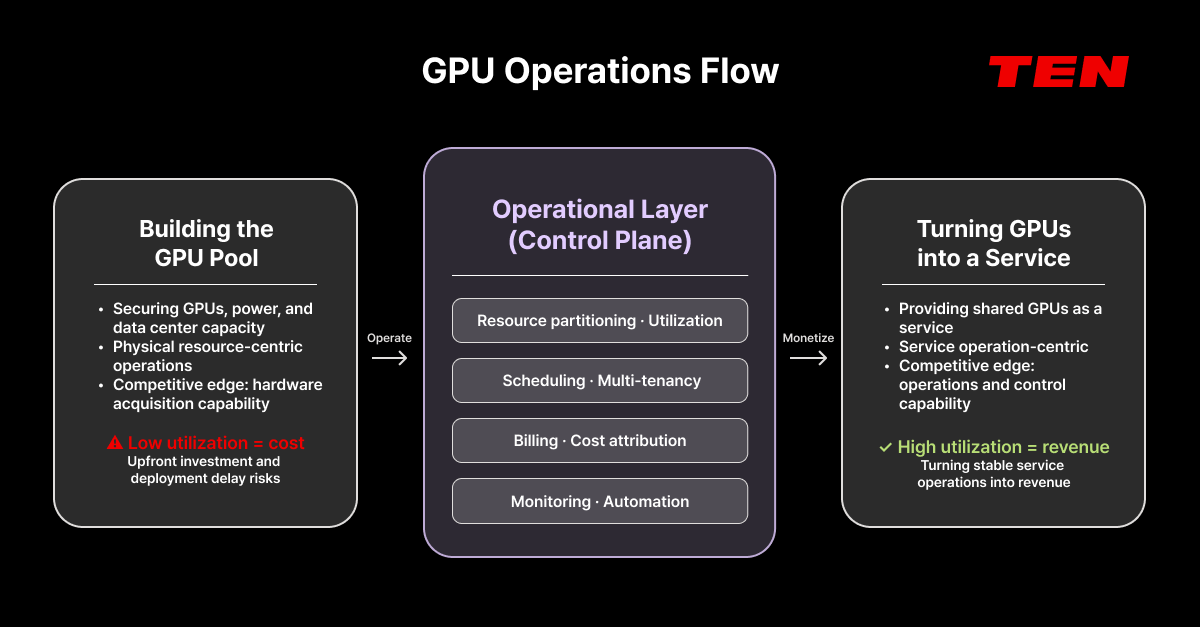
GPU infrastructure requires significant upfront investment. Providers need the latest GPUs, high-speed networking, storage, power, cooling, and data center capacity. At the same time, GPU generation cycles are short, while power and operational costs continue to rise.
As more providers enter the market, pricing competition becomes more intense. Customers expect lower prices and higher reliability at the same time. This means that simply buying GPUs and renting them out by the hour is not enough to build a sustainable business.
Ultimately, the core of a neocloud business is turning GPU assets into service revenue. What makes that possible is the operational layer between the GPU pool and customer-facing services. It partitions resources, places workloads, measures usage, and automates operations.
In short, the competitive advantage in the stage of building a GPU pool comes from hardware acquisition. The competitive advantage in the stage of selling GPU services comes from control capabilities such as scheduling, multi-tenancy, billing, monitoring, and operations automation.
Idle GPUs become cost.
Tenant interference damages trust.
Without usage measurement, billing becomes difficult.
Without monitoring, service quality cannot be guaranteed.
That's why the core of neoclouds and GPUaaS isn't the hardware. It's the operational layer — the control plane — built on top of it.
Five operational capabilities that turn shared GPUs into a profitable service
Neoclouds, AI factories, and internal GPU platforms may have different names, but their operational challenges are similar. To turn shared GPUs into revenue-generating services, five capabilities are essential.
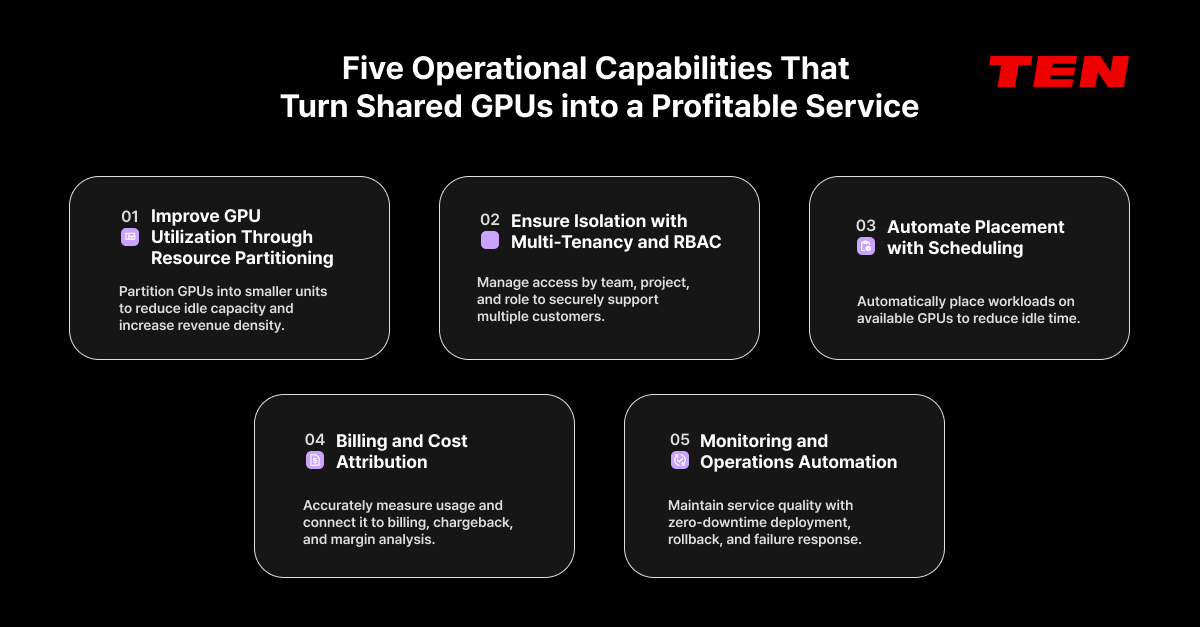
1. Improve utilization through resource partitioning
The biggest source of loss in GPUaaS is idle GPU capacity. When expensive GPUs remain underutilized, revenue does not increase, but depreciation, power, space, and operational costs continue to accumulate.
Not every workload needs an entire GPU. Smaller inference, experimentation, and development workloads should be able to use only the amount of GPU resources they need. With software-based partitioning or MIG options, more workloads can be placed on the same hardware, increasing the revenue density of a GPUaaS business.
2. Ensure isolation with multi-tenancy and RBAC
Neocloud providers operate environments where multiple customers share the same GPU cluster. Internal AI platforms also allow multiple teams, projects, and researchers to share a common GPU pool. In this environment, if one user’s workload affects another user’s performance or data, service trust can quickly break down.
That is why isolation is essential when multiple customers or teams share a cluster. Access must be managed by team, project, and role, while GPU nodes, container images, storage, and service access also need to be controlled. Multi-tenancy is not just a security feature. It is a foundation for monetization because it allows more customers and workloads to be served safely on shared infrastructure.
3. Automatically place workloads with scheduling
As GPU clusters grow, manual operation quickly reaches its limit. In a small environment, an administrator may be able to check which GPUs are available and decide where to place each workload. But as the number of customers, teams, models, and services increases, manual placement becomes a bottleneck.
Workloads must be automatically placed based on resource status and queue conditions. Priority-based allocation, resource reclamation, and reallocation help reduce idle time. Scheduling is a core operational capability that directly affects both GPU utilization and customer wait time.
4. Connect usage to revenue through billing and cost attribution
GPUaaS is, ultimately, a usage-based business.
Providers need to know who used which GPU, for which project, and for how long. Only then can they support billing, internal cost allocation, and margin analysis. For internal platforms, that same data is the foundation for chargeback and showback.
Costs you can't see can't be managed. Usage you can't measure rarely becomes revenue.
5. Protect service quality with monitoring and operations automation
GPUaaS isn't a service that ends at deployment.
Node status, GPU utilization, service uptime, failures, network state, deployment history, rollback readiness — all of it needs continuous management. The more an AI service becomes a customer-facing product, the more operational stability ties directly to revenue and trust.
Zero-downtime updates, rollback, scale-out, load balancing, failover — these are what turn GPU infrastructure from a pile of machines into a reliable service.
Bringing all five capabilities into one platform: AIPub
The challenge is that these five capabilities are usually scattered across separate tools. Stitch partitioning, access control, scheduling, billing, and monitoring together one by one, and operations grow complex. Eventually, they depend on a small group of experts.
AIPub is an AI infrastructure operations platform that brings these capabilities together into a single operational layer.
Built on a Kubernetes-based container platform, AIPub provides spatial GPU partitioning into up to 100 blocks, as well as MIG options. It also supports RBAC-based multi-tenancy across nodes, images, and storage; automatic scheduling; block-level usage-based billing reports; and operations automation such as zero-downtime deployment, rollback, and failure response.
Above all, even non-developers can manage GPU resources and AI services through a web UI. So operations don't have to rest on one or two infrastructure experts. The whole organization can put AI infrastructure to broader use.
Neocloud providers can manage utilization, multi-tenancy, and billing in one platform. Enterprises building AI factories can manage training, inference, and operations workloads together. Organizations running internal GPU platforms can design team-level resource allocation and cost attribution more systematically.
Conclusion: The next competition is about operating GPUs
The rise of neoclouds makes one thing clear.
The value of AI infrastructure no longer comes from GPU ownership alone. Even with the same GPUs, profitability depends on whether they can be operated at high utilization, shared without interference, billed accurately, and delivered as a stable service.
Building a GPU pool is only the starting point. Turning GPUs into a service requires operational capability. AIPub helps organizations build that capability in one platform and turn shared GPU infrastructure into a profitable service.
If you are designing new GPU infrastructure or looking to improve the utilization and operational efficiency of existing GPU resources, RA:X can support the process with benchmarking-based consulting. RA:X helps determine what types of GPUs to adopt, how many are needed, and what operating structure should be designed based on data.